ALTEC MiniMe
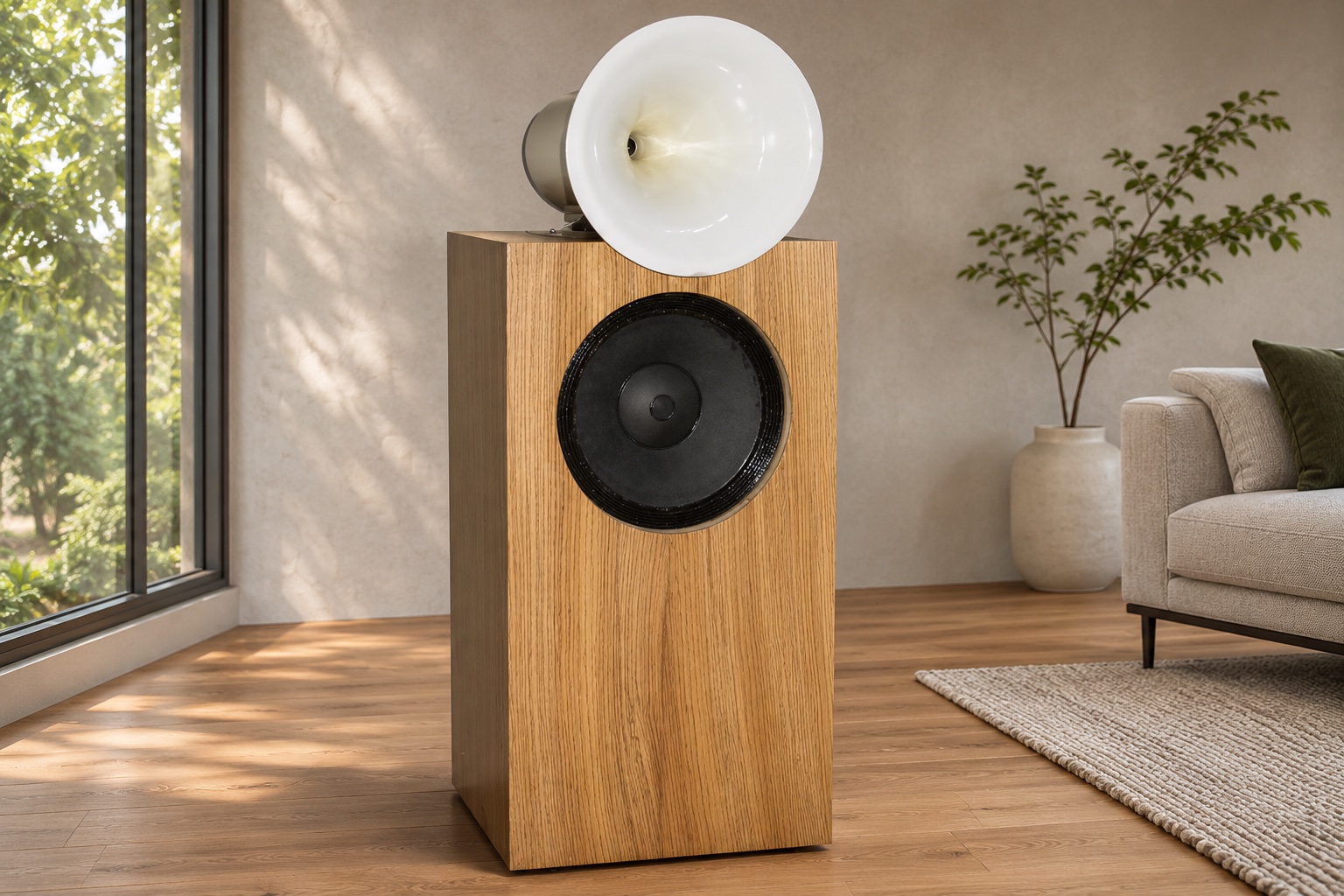

The ‘small’ Altec two-way speaker is finally finished. It now has zebrano veneer and polyurethane lacquer, and the crossover is fixed to the rear panel so its components no longer rattle around inside the cabinet.
Who needs a smaller version as well as the large Altec two-way? Nobody — but it is nice to have them. I suppose it is rather like owning two different Ferraris, two good fountain pens, watches or any other pair of objects, neither of which you really need but both of which are pleasant to own.
How did I end up making two speakers with Altec drivers? Simple: when I decided to build an Altec two-way, I bought both the larger 416C and smaller 414Z bass/midrange units and a model 902 compression tweeter.


I built a cabinet with a replaceable front panel and several bass-reflex openings, allowing tuning by opening or closing them. I also made a circular tractrix horn suitable for the high-frequency driver. After several months of listening with smaller and larger drivers, I chose the larger one. It reached lower and was more sensitive, which seemed more appropriate for the intended 5.5 × 4.8 m listening/living room. The smaller unit sounded so lovely, however, that I decided to build another speaker. When a larger 288-8K compression driver appeared on eBay at a good price, I immediately saw the possibility of two complete Altec loudspeaker systems.
With the horn already made, I ‘only’ needed a suitable enclosure and crossover. The ideal calculation suggested a bass-reflex cabinet of about 120 litres, eventually tuned to 38 Hz. Some crossover work was already complete, and a few more weeks of listening, measurement and adjustment finished it.
A little about making the horn: I calculated it with one of the tractrix calculators available online. Its cutoff is 450 Hz, comfortably low enough for use from a crossover frequency of 900 Hz upwards.
I decided to make a plaster mould and lay several layers of polyester-resin-bonded fibreglass over it. The shape and the plaster’s fragility made releasing the horn difficult. Shoe polish with a high wax content proved the best release agent. A poor release agent caused the first mould to break, but the horn turned out well, so I cast the next mould from it.

Laborious filling, sanding and painting followed, but the horns eventually turned out rather well.


Both crossover sections have 12 dB/octave slopes, with a crossover frequency around 1,300 Hz. The measured result is reasonably flat and sounds exceptionally good. Flatter results were achieved during development, but this crossover sounds best. Standard components leave room for improvement: ferrite-core inductors, MKP capacitors in the high-frequency section, a bipolar electrolytic in the bass section, and metal-oxide resistors.

The sound is dynamic, balanced and transparent. Particularly important to me, the speaker does not favour any type of music or recording. It works equally well with polished modern recordings and even better with recordings half a century old. Its high sensitivity, 94 dB/W/m, allows excellent performance with only a few watts, helped by high impedance: the Altec 414Z is a 16-ohm driver. In the listening room MiniMe stands beside large Tannoy HPD385s, making comparison inevitable. The Tannoy sounds softer and more relaxed, an ‘easy-listening’ presentation. MiniMe is more dynamic and immediate; with jazz it reminds me more of what I regularly hear in Lisinski’s small concert hall.

Toni’s MiniMe
Until recently Toni enjoyed large Tannoy 15-inch K3838 coaxials, then decided it was time for a change. Encouraged by what he heard in my room, he chose this project. Used drivers in excellent condition were bought online from the United States. I no longer felt like making horns again, and Toni never considered it, so I recommended ready-made horns from Polish manufacturer Autotech, which offers many profiles and applications. I chose the IWATA-600. The different horn required crossover changes, but the resulting frequency response is almost identical to the original. As always, Toni took great care over design and finish. The result is an excellent speaker that substantially outperforms its predecessor in his room.


Approximate summed response: Altec 414-16B measured in the near field at 40 cm; Altec 902-8T with Iwata 600 measured at 1 m.

Complete loudspeaker response measured by MLS at a distance of 1.5 m.

DrZ Lab